⛏️⚠️ New Mining Update — Mines Act Repealed (21 November 2025)
Govt. of India | Ministry of Labour & Employment
📍 New Delhi
📜 Background – Why This Matters
For 70 years, Indian mines were governed by the Mines Act, 1952 and Mines Rules, 1955. These laws were created for a different era — before mechanised mines, before modern safety standards, and before nationwide social security systems.
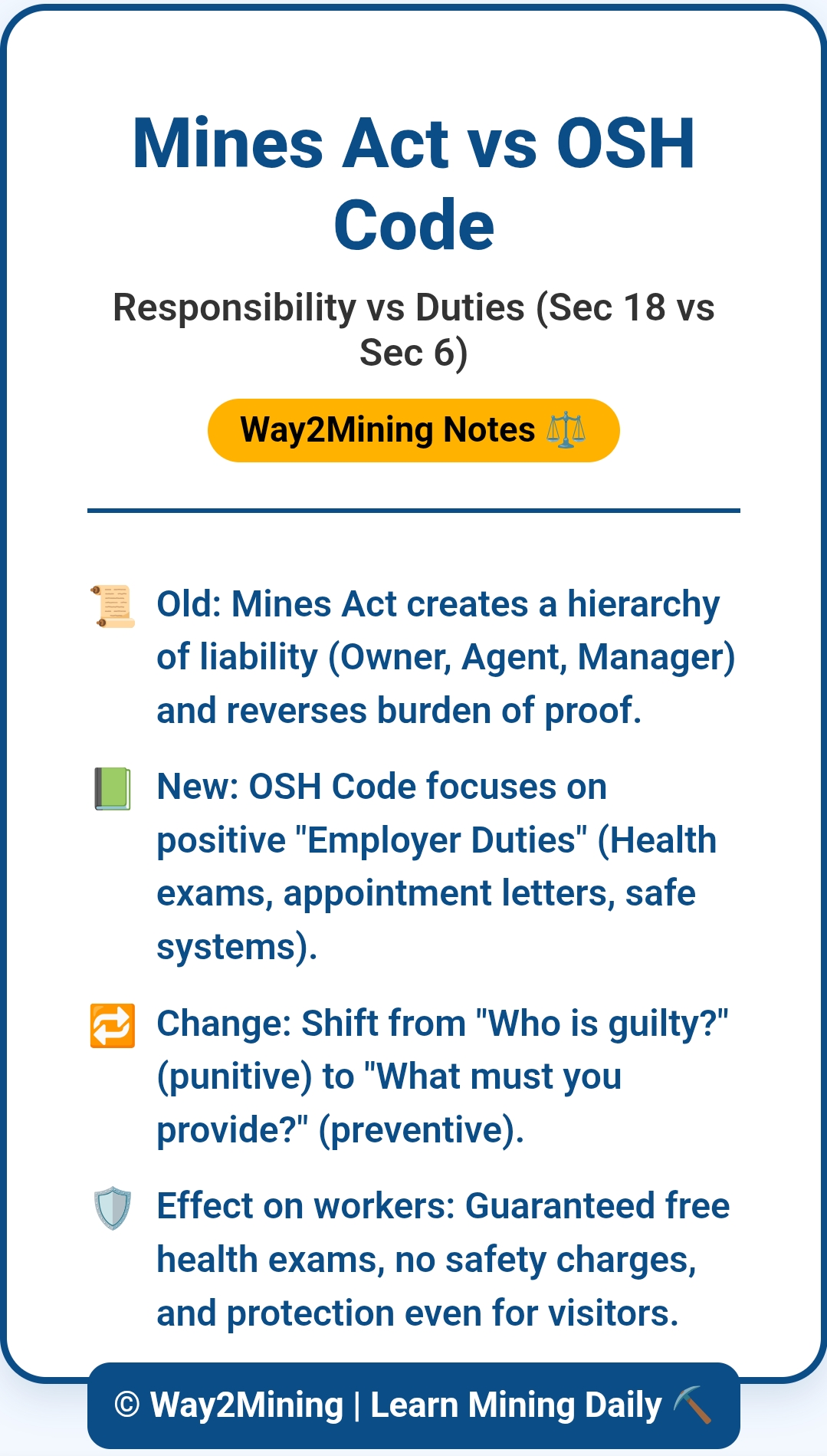
On 21 November 2025, the Government made the Four Labour Codes effective. This historic step officially repeals the Mines Act and replaces it with a single, modern law for all mines — the OSHWC Code, 2020.
👉 This is the biggest legal change for the mining sector since Independence.
🛑 What Exactly Changed?
- The Mines Act, 1952 is no longer in force.
- Mines Rules, 1955 are fully repealed.
- All Indian mines (underground, opencast, quarries, MDO-operated mines) now fall under the OSHWC Code.
🏛️ Key Changes for Mining Workers (NEW in 2025)
1️⃣ Appointment Letter is Now Mandatory
Every miner — permanent, contract, outsourced or FTE — must get a formal appointment letter. No letter = illegal employment.
2️⃣ Annual Health Check-Up Compulsory
Workers aged 40+ must receive a free yearly medical examination. This was NOT guaranteed under the Mines Act.
3️⃣ Commuting Accident = Employment Accident
Certain travel accidents to/from mine sites can now be treated as occupational accidents, making workers eligible for compensation and ESIC benefits.
4️⃣ Women Allowed in Underground & Night Shifts
The earlier complete ban on women in underground mines is gone. Women may work in any mine role (with consent + safety measures).
5️⃣ ESIC Coverage is PAN-India
Even mines with one worker engaged in hazardous processes must provide ESIC. Many mining belts gain coverage for the first time.
6️⃣ Social Security for Contract & Gig Miners
The principal employer must now ensure PF, ESIC, insurance, and social security for contract mining labour. FTE miners get gratuity after 1 year.
7️⃣ National Safety Standards for Mines
Instead of multiple old rules, uniform national safety standards will now govern ventilation, dust, machinery, blasting, and hazardous work.
8️⃣ Single Registration & Single Return
Mining establishments now file one licence, one registration, and one return, replacing scattered systems under the Mines Act.
✨ Simple Story Example
Rajappa, an underground miner from Ballari, worked through a contractor for 11 years without an appointment letter or ESIC. Under the Mines Act, he had no formal proof of service.
👉 After 21 Nov 2025, his employer must issue him a legal appointment letter and provide ESIC coverage.
When he travels 18 km to the mine every morning, any qualifying accident on this route can now count as a work-related accident. Rajappa finally gets protection the old Act never gave.
🔍 Ground Reality – Why This Change Is Important
- ✔ Brings mining laws in line with modern global standards
- ✔ Gives contract miners long-awaited legal protections
- ✔ Strengthens health surveillance for dust-related diseases
- ✔ Provides women equal opportunity in mining roles
- ✔ Ensures nationwide ESIC access for remote mineral belts
- ✔ Replaces outdated, scattered mining rules with one unified Code
🔑 Takeaway
- ⛏️ Mines Act is repealed — OSHWC Code now governs all mines
- ⚕️ Stronger health, safety, and social security for miners
- 🛡️ Contract & outsourced workers gain legal protection
- 📘 Clear, modern, single-rulebook mining governance

Share This News