⚖️ Mines Act vs OSH Code — Duties & Liability
Simple comparison for mining students and professionals 🚧
📘 Quick Summary
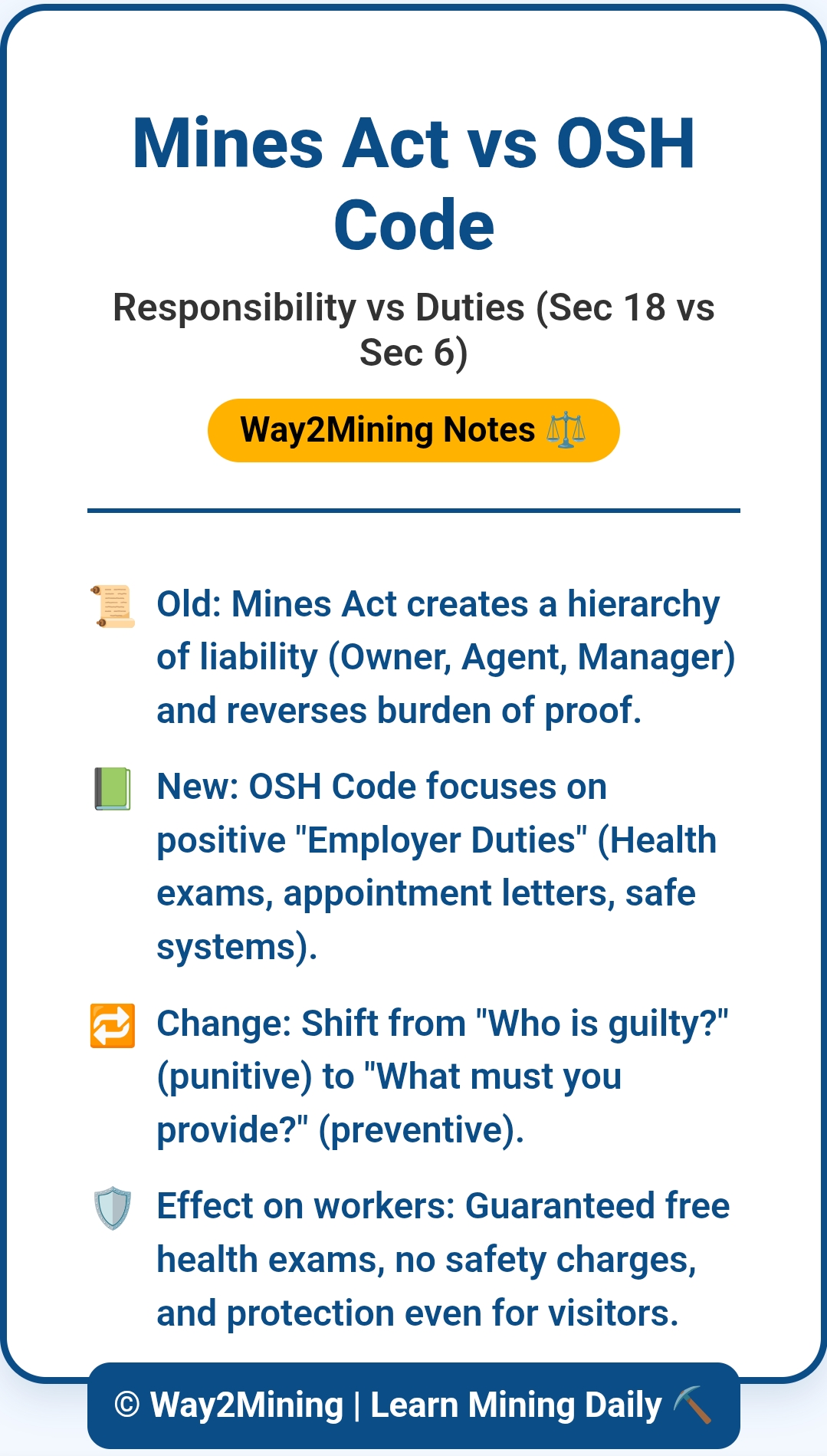
The old law (Mines Act) creates a "pyramid of blame," focusing on who is liable when accidents happen. The new OSH Code shifts to "preventive duties," listing exactly what employers must provide (like free health exams and appointment letters) to keep everyone safe.
📜 Old Law – Mines Act (Sec 18)
- Hierarchy: Owners, Agents, and Managers are jointly responsible.
- Resources: Owners must provide funds; "lack of money" is no excuse.
- Reversed Proof: If a violation occurs, you are guilty unless you prove you used "due diligence."
- Focus: Primarily punitive—who gets punished for violations?
📗 New Law – OSH Code (Sec 6)
- Employer Duty: Must ensure a workplace "free from hazards."
- New Rights: Mandatory appointment letters, free annual health exams, and no charging workers for safety gear.
- Broad Scope: Safety duty extends to anyone on premises, even visitors or trespassers.
- Focus: Preventive—what must be done to avoid accidents?
📊 Side-by-Side Comparison
| Aspect | Mines Act (Sec 18) | OSH Code (Sec 6) |
|---|---|---|
| Core Philosophy | Punitive: "Who is liable?" (Enforcement oriented) | Preventive: "What must be done?" (Duty oriented) |
| Responsibility | Hierarchy: Owner, Agent, Manager & Officials. | The "Employer" holds the primary duty. |
| Burden of Proof | Reversed: You are guilty until you prove innocence (due diligence). | Standard compliance duties; less focus on automatic guilt loops. |
| Worker Rights | Silent on specific admin rights like letters. | Mandates appointment letters & free health exams. |
| Cost of Safety | Implied responsibility of Owner. | Explicitly forbids charging employees for safety items. |
🔍 What Changed & Why It Matters
The biggest shift is from a "web of liability" to a "charter of duties." Under the Mines Act, managers often felt the heat of automatic liability. The OSH Code modernizes this by adding specific welfare requirements (like e-waste disposal and health checks) and explicitly stating that safety costs cannot be passed to workers. It also covers everyone on site, not just employees.

Share This News