⚖️ Mines Act vs OSH Code — National Advisory Board
Simple comparison for mining students and professionals 🚧
📘 Quick Summary
The OSH Code replaces the sector-specific "Committees" of the Mines Act with a unified National Occupational Safety and Health Advisory Board. This shift moves from a mining-only advisory body to a multi-sectoral board that harmonizes safety standards across factories, mines, and docks.
📜 Old Law – Section 12 (Mines Act, 1952)
- Composition: Led by a Chairman (Govt. service, not DGMS), plus the Chief Inspector (DGMS), 2 miners' reps, 2 owners' reps, and 2 independent mining engineers.
- Focus: Specifically focused on mining safety, local mining issues, or specific groups of mines.
- Power: Functioned largely as an advisory body to the Central Govt for the purposes of the Mines Act.
📗 New Law – Section 16 (OSH Code, 2020)
- Composition: Much larger! Led by the Secretary (Labour Ministry) as Chairperson. Includes DGMS, CPCB Chairman, and representatives from 4 States, Employers (5), and Employees (5).
- Technical Committees: Allows for specialized technical committees to handle specific industry needs (like mining).
- Scope: Broad oversight on standards, rules, and OSH policy implementation nationwide.
📊 Side-by-Side Comparison
| Aspect | Mines Act (Section 12) | OSH Code (Section 16) |
|---|---|---|
| Primary Board | Mining Committee | National OSH Advisory Board |
| Chairperson | Govt. Appointee (Non-DGMS) | Secretary, MoL&E (Ex-Officio) |
| Board Tenure | Not fixed (as per notification) | 3 Years (for non-official members) |
| State Representation | Not mandatory | 4 States (by rotation) |
🔍 What Changed & Why It Matters
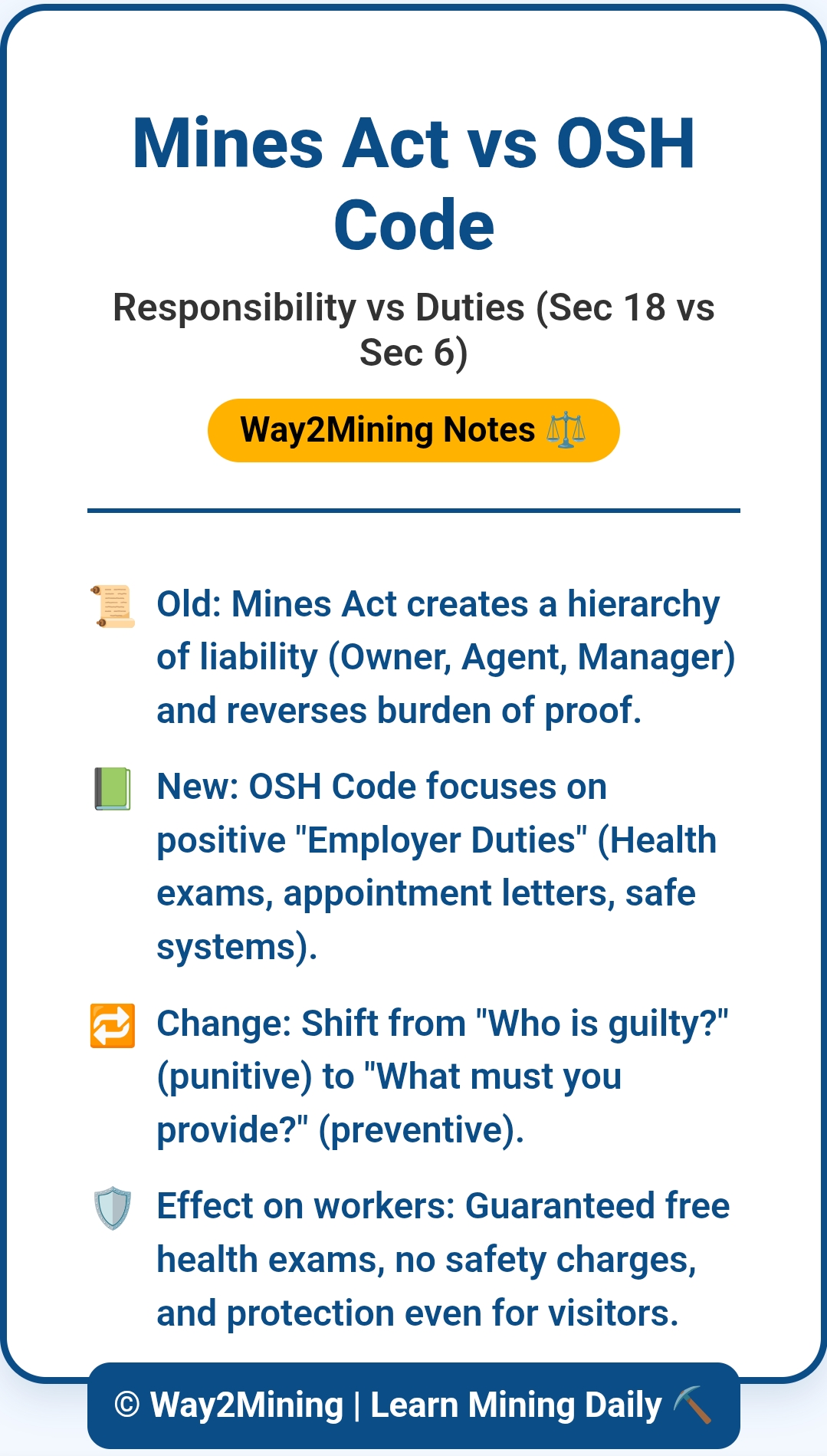
1. Centralization: Instead of fragmented boards for different acts, one National Board ensures uniform safety standards across all Indian industries.
2. Broader Expertise: Inclusion of the Central Pollution Control Board (CPCB) and Health Services reflects a modern approach linking industrial safety with environmental health.
3. Rotation of Power: Rotating State representatives ensures that local mining or industrial concerns from different regions get a voice at the national level.
4. Flexibility: The ability to form "Technical Committees" means specialized mining expertise is preserved even within a larger general board.

Share This News