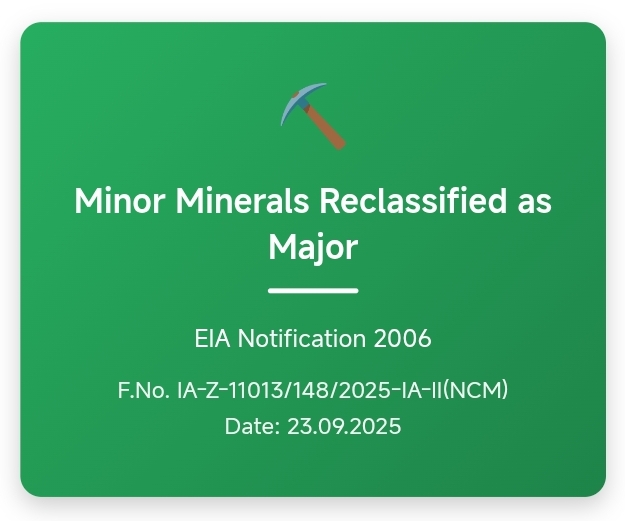
Minor Minerals Reclassified as Major: What Small Miners Must Know – EIA Notification 2006, F.No. IA-Z-11013/148/2025-IA-II(NCM), 23.09.2025
Minor Minerals Reclassified as Major? What Small Miners Need to Know ⛏️🌿
Imagine you’re a small miner in Rajasthan, running a 4-hectare feldspar mine. Everything’s running smoothly under the EIA Notification, 2006, which classifies your project as a B2 category — simple paperwork, state-level appraisal, and no major hurdles.
Suddenly, you hear the news: feldspar is now a “major” mineral. Alarm bells ring — do you now face extra paperwork, longer approvals, or stricter environmental scrutiny?
A Little Background: EIA Notification, 2006 📜
The EIA Notification, 2006 categorizes mining projects based on environmental impact:
- Category A: Large projects with potentially significant environmental impact.
- Category B: Smaller projects, further divided into:
- B1: Medium risk or size projects
- B2: Low-risk, small projects (usually ≤5 hectares)
Historically, minor minerals like mica, quartz, feldspar, and baryte with small lease areas fell under B2, meaning a simplified, state-level environmental clearance.
What Changed? 🔄
Recently, the Ministry of Mines reclassified some minor minerals as major. Naturally, this created confusion among small miners: would your 3-hectare mica mine suddenly require Category A-level scrutiny?
“The environmental footprint and pollution load of a mining project is primarily determined by lease area and method of extraction, not whether the mineral is minor or major.”
The Government Clarifies: B2 Remains for Small Mines ✅
- Mining projects of reclassified minerals with lease area ≤5 hectares will continue as B2 projects.
- SEAC/SEIAA will review the Environmental Management Plan (EMP) and may suggest additional safeguards, but the basic clearance process remains unchanged.
Live Examples: Relating to Real Miners 🏞️
- Jharkhand – Mica Mine (2 hectares)
Before: Minor mineral → B2 project ✅
After: Major mineral → Still B2, same SEIAA appraisal, no central-level scrutiny.
- Andhra Pradesh – Quartz Mining (5 hectares)
Before: Minor mineral → B2 project ✅
After: Major mineral → No change. EMP reviewed, operations continue.
- Rajasthan – Feldspar Mine (4 hectares)
Miner worried about extra paperwork, but circular confirms: process remains B2, just continue following environmental safeguards.
Why This Matters 💡
- Small miners benefit: No added bureaucracy for projects ≤5 hectares.
- Environment is protected: Proper safeguards and EMPs are still mandatory.
- Clarity and efficiency: Streamlined process avoids unnecessary delays.
Bottom line: Minor minerals becoming “major” doesn’t create extra headaches for small miners. 🌱 Just remember to follow proper environmental practices, and you’re good to go.
Share This News