Way2mining
Ariyalur District
Tamilnadu.
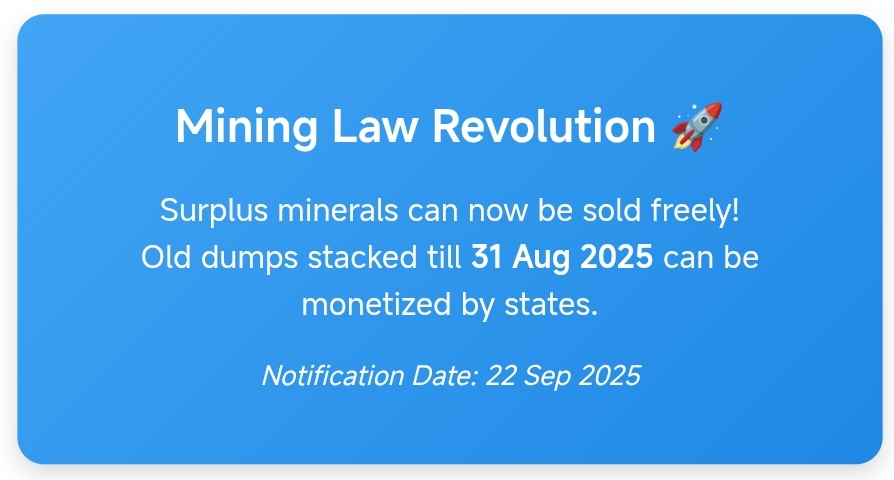
On 22nd September 2025, the Ministry of Mines issued an important order under the MMDR Amendment Act, 2025. This is a major shift in how minerals can be sold and how states can manage old mineral dumps, turning “waste” into revenue.
Mining in India is governed by the Mines and Minerals (Development and Regulation) Act, 1957 (MMDR Act). Over time, amendments balanced industrial demand, transparency, environmental safeguards, and state revenue. Section 8A(7A) deals with captive mines — those linked to end-use plants, like steel mills. It answers: “If a mine produces more than its plant needs, what happens to the extra?”
The law was restrictive. It read:
“Any lessee may, where mineral is used for captive purpose, sell mineral up to fifty per cent. of the total mineral produced in a year after meeting the requirement of the end use plant linked with the mine, in such manner as may be prescribed by the Central Government and on payment of such additional amount as specified in the Sixth Schedule:”
| Aspect | Before 2025 | After 2025 |
|---|---|---|
| Sale of surplus from captive mines | Only up to 50% allowed | Any quantity allowed |
| Who could sell more than 50% | Government companies only | All lessees (Govt & private) |
| Control over dump sales | Only Centre | States empowered (dumps stacked ≤31 Aug 2025) |
| Environmental impact | Dumps lying unused | Dumps cleared & monetized |
| Benefits to companies | Limited cashflow | More revenue & flexibility |
This is not just a minor tweak — it is a paradigm shift. The 2025 amendment transforms:
As one industry veteran puts it: “What was once waste is now wealth.” The mining sector is watching closely — this could redefine efficiency, revenue, and sustainability in India’s mining industry.

Share This News