Way2mining
Ariyalur District
Tamilnadu.
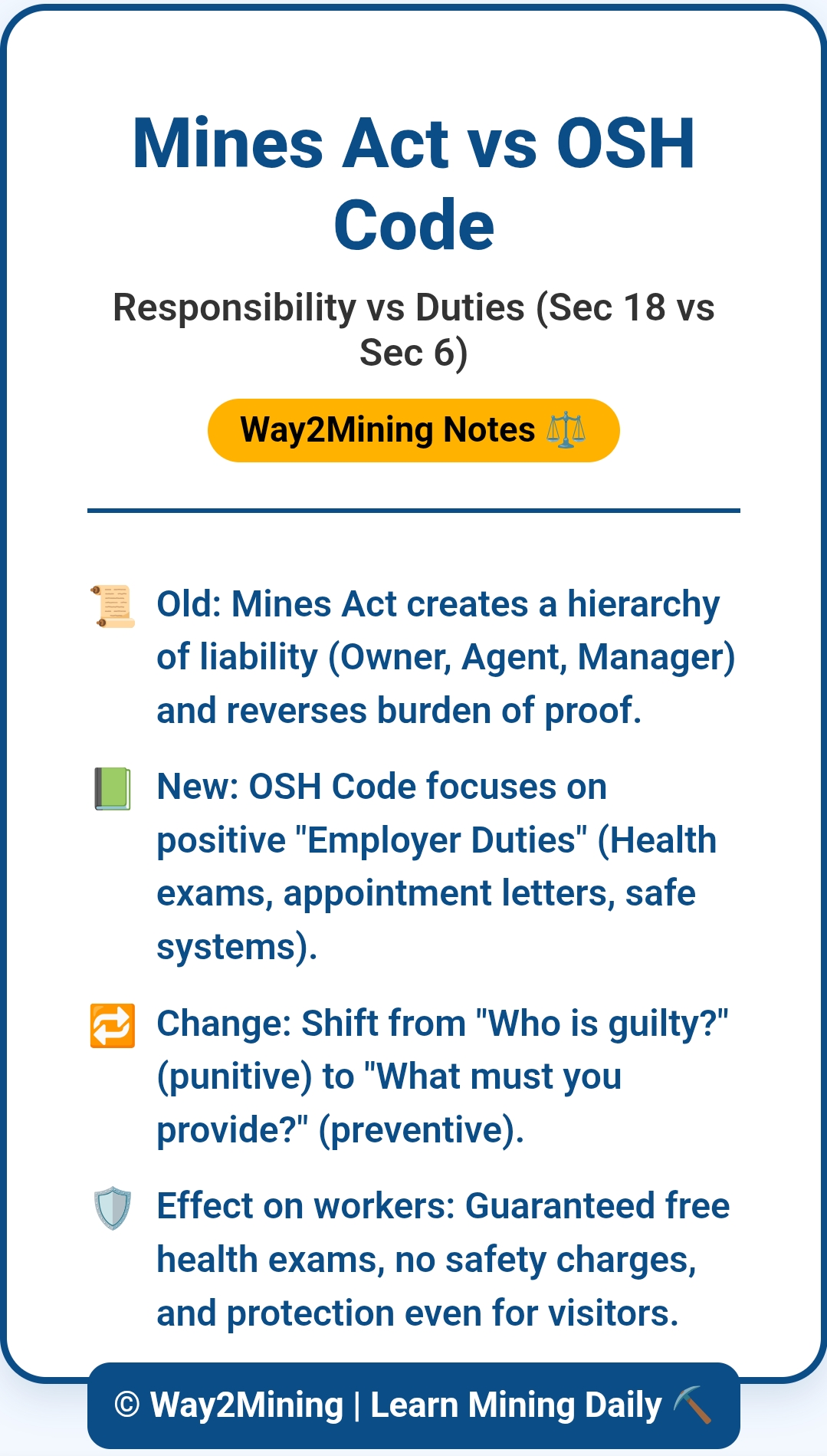
Who is liable when accidents happen? 📉 We compare Mines Act Sec 18 (Owner/Agent/Manager liability) with OSH Code Sec 6 (Employer Duties) to show the shift from punishment to prevention. ⚖️🚧
Comparing how occupational diseases are reported under old Mines Act vs new OSH Code. Key changes involve doctor penalties, the disease list, and reporting scope. 🏥
Comparing Section 23 of the Mines Act with Section 10 of the OSH Code. Learn how accident reporting thresholds and transparency rules have changed for the mining industry. 🚧
How do you inform the government before starting a mine? We compare the old Mines Act Section 16 with the new OSH Code Section 5. 📢
A detailed comparison between the Section 12 Committees of the Mines Act and the new National OSH Advisory Board under the OSH Code 2020. Learn how administrative oversight is evolving 🏗️.
Comparison of government powers to enter mines for surveying. The 3-day notice rule remains, but titles have evolved to "Facilitator". 👷♂️
Prospecting and quarrying exemptions have changed! The OSH Code removes hard limits (like 6m depth or 20 persons) from the main text and moves them to rules. 🚧
We compare Section 20 of the Mines Act 1952 with Section 23 of the OSH Code 2020. The major update? Separate facilities for transgender employees. 🚻
We compare Section 22 of the Mines Act 1952 with Section 38 of the OSH Code 2020. Learn how the Inspector's powers to handle unforeseen dangers have been streamlined. 👷♂️
From "Inspector" to "Facilitator" — discover how the OSH Code expands inspection powers to include digital evidence, sensitization, and on-spot testing compared to the old Mines Act. 👮♂️